
The Lucky Seven: Washington, DC’s Most Historic Co-op Buildings
If you’ve been reading my blog for a while, you already know I have a soft spot for Washington’s historic co-op buildings.
After nearly four decades selling real estate in the DC area, I’ve walked through hundreds of beautiful homes. Some are sleek and modern with floor-to-ceiling glass. Others are brand new and loaded with technology. But every once in a while I walk into a historic co-op and immediately think, “Now this building has stories to tell.”
These aren’t simply old apartment buildings. They’re pieces of Washington history. They were built when craftsmen carved stone by hand, when lobbies were designed to impress, and when apartments featured gracious floor plans instead of squeezing every possible square foot into a building.
If you’re looking for character, architecture, and a little old-world charm, here are my Lucky Seven.
1. The Ponce de Leon (1928)
The Ponce de Leon Apartment Building is a historic structure at 4514 Connecticut Avenue, just north of Albemarle Street in the Wakefield neighborhood. It was designed by David L. Stern in a combination of the Mission Revival and the Spanish Revival styles, reflecting the exoticism of the 1920s.
The exterior features diapered brickwork, terra cotta tile roof, limestone portico and trim, and Moorish arch motifs. The interior features an intact lobby with a decorative plaster ceiling and a terrazzo floor. It was listed on the National Register of Historic Places in 1994.
The location offers exceptional convenience with a remarkable collection of neighborhood destinations just steps away. Enjoy easy access to local favorites including Bread Furst, Sfoglina, Comet Ping Pong, Rosemary Bistro Cafe, and Italian Pizza Kitchen. Daily conveniences are equally close, including Politics and Prose, Calvert Woodley Fine Wines & Spirits, Mom’s Organic Market, Giant Food, CVS, and the popular New Morning Farm at Sheridan School and UDC Farmers Markets held weekly. Outdoor recreation is moments away with the Soapstone Valley Trail entrance just four minutes away on Albemarle Street, providing a scenic path directly into Rock Creek Park.
Residents enjoy convenient building amenities including laundry on every floor, a bike storage room, and the option to install an in-unit washer and dryer with board approval. Parking is available for rent. The building is pet-friendly, and rentals are permitted with restrictions. The cooperative fee includes heat, water, sewer, building maintenance, insurance, and property taxes. The building has no underlying mortgage and no special assessments. Timeless architecture, generous proportions, thoughtful upgrades, and an exceptionally walkable location define life at The Ponce.
A one bedroom unit on the top floor with 1300 square feet sold in April 2026 for $560,000 and an 1100 square foot one bedroom unit on the second floor sold in June for $467,500.
2. 2101 Connecticut Avenue (1928)
Welcome to 2101 Connecticut, designed by Joseph Abel and George Santmyers in 1927. Opened as a high-end rental by BF Saul in 1928, it was converted to a co-op in 1976. According to James Goode, author of Best Addresses, the builder, Harry J. Bralove, said “Occupying the entire frontage on Connecticut Avenue between Wyoming Avenue and Kalorama Road, 2101 Connecticut Avenue is located in Washington’s most fashionable residential center. It crowns one of the highest points in the city of Washington and is so designed that each apartment has three exposures, thus assuring a maximum of light and ventilation.” 2101 Connecticut is perfectly located in Kalorama, an easy walk to the Dupont and Woodley Metro stops, The Phillips Collection, restaurants in Dupont, Adams Morgan and Woodley, many shops, coffee and gelato bars, galleries, supermarkets, the ever popular Sunday Dupont Farmer’s Market, plus all the services you need.(I confess that this has always been one of my favorite buildings on Connecticut Avenue!)
A stunning four-bedroom three bath unit with 3200 square feet of space sold for $2,950,000 in June 2026 while another of the same size sold for $2,875,000 in May 2026.
3. The Chastleton (1920)
The Chastleton is impossible to miss. Located at 1701 16th Street, it looks like a castle rather than a residential building! With its Gothic Revival architecture, soaring entrance, gargoyles, and dramatic brick façade, you may be expecting to meet Cinderella inside. Walk through the front doors into the lobby and you’ll find one of the city’s most fascinating cooperative communities, blending history with modern urban living. The Chastleton offers all the neighborhood conveniences you need right outside your front door, with easy access to all things D.C.
In 2006, The Chastleton underwent restoration to reclaim the glory of its architectural details both inside and out, offering today’s updated features. The lobby and hallways have been stunningly updated to showcase the grand elegance of The Chastleton. The Coop offers on-site professional management; 24/7 front desk/Security Guards; a well-equipped fitness center; a large ballroom for hosting parties & events; a tranquil courtyard with grills; community laundry room; rental storage units; gated on-site parking; bike storage; and a roof deck with sweeping views of D.C.’s monuments and skyline.
It’s one of those buildings that people stop to admire—even if they’ve never stepped inside.
4. Tilden Gardens (1927–1930)
Located in the Cleveland Park Historic District, the venerable Tilden Gardens cooperative is within short walking distance to two Metro stations (Cleveland Park and Van Ness), Rock Creek Park, Hillwood and all the shops and restaurants along “the Avenue.” Tilden Gardens Cooperative is a group of six Tudor Revival style buildings set amidst five acres of lavishly landscaped grounds that feature mature trees, elegant terraced gardens and enchanting pea gravel walkways. The complex has been home to many famous residents, including former president Harry Truman.
Tilden Gardens’ main building located at 3000 Tilden St. NW, is home to the front desk and the building’s elegant, resident-reservable lobby. The cooperative provides front desk services 7am–11pm daily, including holidays, and residents may reserve the lobby to host private gatherings. Laundry facilities are on-site and available free to residents. All units have extra storage bins. Garage parking is available for rent on a wait-list basis. The co-op conveniently maintains two guest apartments (one with a queen bed; the other with two twin beds) available for rent to residents’ overnight guests. Pets are prohibited and the renting of units is restricted.
Its famous gardens, fountains, winding pathways, and Tudor Revival architecture make it unlike anything else in the city. Nearly a century later, residents still enjoy the peaceful oasis envisioned by its original designers. A three bedroom two bath unit with 1675 square feet sold in April 2026 for $1, 019,000.
5. The Broadmoor (1928)
The Broadmoor at 3601 Connecticut Ave. may have the most spectacular lobby of any cooperative in Washington. Step through the front doors and you’re greeted by marble floors, dramatic staircases, ornate plaster ceilings, and old-world elegance that immediately transports you to another era.
6. The Westchester (1931)
If Washington had a grand country estate disguised as a cooperative, the Westchester would be it.
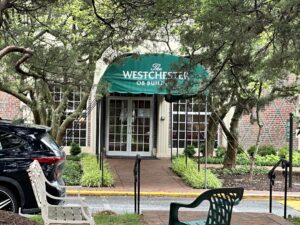 At The Westchester, the scale is grand. The buildings were constructed between 1929 and 1931 on one of the city’s highest points at 4000 Cathedral Ave. NW. Originally envisioned by developer Gustave Ring as the largest apartment complex south of New York City, the plan called for eight buildings over 28 acres, but the Great Depression halted construction. Only four buildings (with 556 units) were completed, leaving much of the landscaped site undeveloped.
The complex was designed by architect Harvey Warwick, Sr., in a mix of Neo-Georgian, Neo-Tudor, and Neo-Moorish styles, with limestone ornamentation and imposing brick facades. It was intended to be a luxury residential enclave, and today it remains one of Washington’s largest co-ops, housing over 500 apartments ranging from studios to four bedrooms.
As you come into the Westchester, be sure to admire the estate gates from the Copped Hall Trust in England. These grand gates remain a distinctive feature of the property. Three of the Westchester’s buildings are connected to one another. Long hallways, soaring ceilings, and a campus-like layout give it an almost estate feel. Many units feature classic details like parquet floors, built-ins, and generous room sizes. You not only need to keep track of the unit number but also the building, The four buildings on ten acres are centered around a small sunken garden and a quiet drive from Cathedral to the rear of the community where you will find the final building in the complex, the separate Watson Place, which was built in 1960.
There’s simply nothing else quite like it.
7. The Mendota (1901)
Long before luxury condominiums became fashionable, The Mendota was setting the standard for elegant city living at 2220 20th Street NW, Washington, DC 20009. Its Beaux Arts style, limestone façade, graceful arches, ornamental details, and beautifully proportioned apartments reflect an era when buildings were designed to last for generations—not just decades. Inside, you’ll find many of the features buyers still search for today: high ceilings, oversized windows, generous room sizes, hardwood floors, and remarkable architectural details that simply can’t be replicated in most new construction.
The Mendota has earned a reputation as one of Washington’s most desirable boutique cooperatives. Featured in Goode’s Best Addresses, The Mendota was the first apartment building constructed in Kalorama Triangle and lies at the corner of 20th Street and Kalorama Road. In 1901 at the time of its construction, the Mendota, built by architects Hornblower and Marshall, offered an upscale housing alternative to ownership of a row house in the District. Today the 7-story building features 48 residences with some of the most generous floor plans in the District. Residents enjoy the elegant lobby and vintage, manually operated elevator. The apartments offer a number of significant architectural details ranging from 10 foot ceilings to oversize windows, original crown moldings and Victorian-tiled fireplaces. Building amenities include a parlor, courtyard, bicycle storage and 24×7 front desk. The Mendota is within walking distance of the Woodley Park Metro Station.
The surrounding Kalorama and Adams Morgan neighborhoods offer an extraordinary quality of life, with Kalorama Park’s three acres of gardens and green space and the trails of nearby Rock Creek Park just moments away. The diverse dining scene is exceptional, including Lapis (Afgan) and Perry’s (Japanese) alongside beloved neighborhood staples like Tryst and the iconic Madam’s Organ, a live music and blues bar that has anchored the neighborhood’s nightlife for over two decades. With a farmers’ market, independent bookshops, boutique retail, and an endlessly walkable streetscape all outside your door, this is truly Washington living at its finest.
For buyers who appreciate craftsmanship, history, and timeless elegance, The Mendota is truly one of Washington’s hidden gems.
Frequently Asked Questions About Historic Co-ops in Washington, DC
What is a co-op in Washington, DC?
A cooperative, or co-op, is a form of home ownership in which you purchase shares in a corporation that owns the building rather than owning your individual apartment outright. Those shares give you the exclusive right to occupy a specific residence. Many of Washington’s most prestigious historic buildings are organized as cooperatives.
Are historic co-ops less expensive than condominiums?
Sometimes. The purchase price of a co-op is often lower than a comparable condominium, but buyers should also consider the monthly co-op fee. Many fees include property taxes, building insurance, exterior maintenance, reserve funding, and some utilities, making monthly expenses easier to predict.
Why are so many of Washington’s historic buildings cooperatives?
Before condominiums became popular in the 1960s and 1970s, cooperatives were the preferred way to develop luxury apartment buildings. Many of Washington’s grandest residential buildings were built as co-ops during the early twentieth century and have remained that way ever since.
Can you get a mortgage to buy a co-op?
Yes. Many lenders finance cooperative apartments, although the process is different from financing a condominium or single-family home. Working with a lender experienced in DC co-op financing can make the process much smoother.
Do co-ops have stricter rules than condominiums?
Generally, yes. Most co-ops have a board approval process and established policies regarding renovations, pets, leasing, and ownership. Many buyers appreciate these rules because they help protect the building’s financial stability and long-term value.
What makes historic co-ops different from newer buildings?
Historic co-ops often feature architectural details that are difficult to replicate today, including higher ceilings, hardwood floors, crown molding, larger room sizes, masonry construction, handcrafted stonework, and beautifully landscaped grounds. Many buyers also appreciate the unique history and character these buildings offer.
Which Washington, DC neighborhoods have the most historic co-ops?
Many of the city’s best-known historic cooperatives are found in Kalorama, Dupont Circle, Cleveland Park, Cathedral Heights, Adams Morgan, and Upper Northwest Washington.
Are co-op fees higher than condo fees?
They can be, but it’s important to compare what is included. Many co-op fees cover expenses that condominium owners pay separately, such as real estate taxes, some utilities, master insurance, maintenance, and contributions to building reserves.
Are historic co-ops a good investment?
While no one can guarantee future appreciation, many historic co-ops have maintained strong demand for decades because of their architecture, prime locations, limited inventory, and timeless appeal. Buyers are often drawn to their unique character and enduring quality.
Which historic co-op is right for me?
That depends on your lifestyle and priorities. Some buyers want expansive gardens and larger residences like those at The Westchester or Tilden Gardens, while others prefer boutique buildings such as The Mendota or The Ponce de Leon. The best choice is the one that fits your budget, lifestyle, and long-term goals.
ABOUT THE AUTHOR
Lise Howe is an Associate Broker with RLAH @properties and has been helping buyers and sellers throughout Bethesda, Chevy Chase, Montgomery County, and Washington, DC for nearly 40 years. Known for her warm, personalized approach and deep knowledge of the local market, Lise believes that every client deserves honest advice, clear communication, and an advocate who genuinely cares about their goals.
Whether working with first-time buyers, downsizers, or luxury home clients, Lise combines decades of experience with a commitment to making every real estate transaction as smooth and enjoyable as possible. When she’s not helping clients, you’ll often find her walking the Capital Crescent Trail with Captain, exploring local neighborhoods, or sharing insights about the communities she loves.